CVE-2026-44578
Next.js Server-Side Request Forgery Vulnerability
CVE-2026-44578 is a High-severity server-side request forgery vulnerability affecting self-hosted Next.js applications that use the built-in Node.js server. The vulnerability exists in WebSocket upgrade request handling, where crafted requests can cause the server to proxy connections to arbitrary internal or external destinations. Vercel-hosted deployments are not affected.
Technical Details
Next.js is an open-source React framework for building full-stack web applications. In affected self-hosted deployments, crafted WebSocket upgrade requests can abuse the built-in Node.js server and cause it to proxy requests to attacker-selected destinations.
This may expose internal services, administrative interfaces, or cloud metadata endpoints reachable from the affected server. The issue is tracked as CWE-918 and has a CVSS 3.1 score of 8.6, rated High.
NodeZero® Proactive Security Platform — Rapid Response
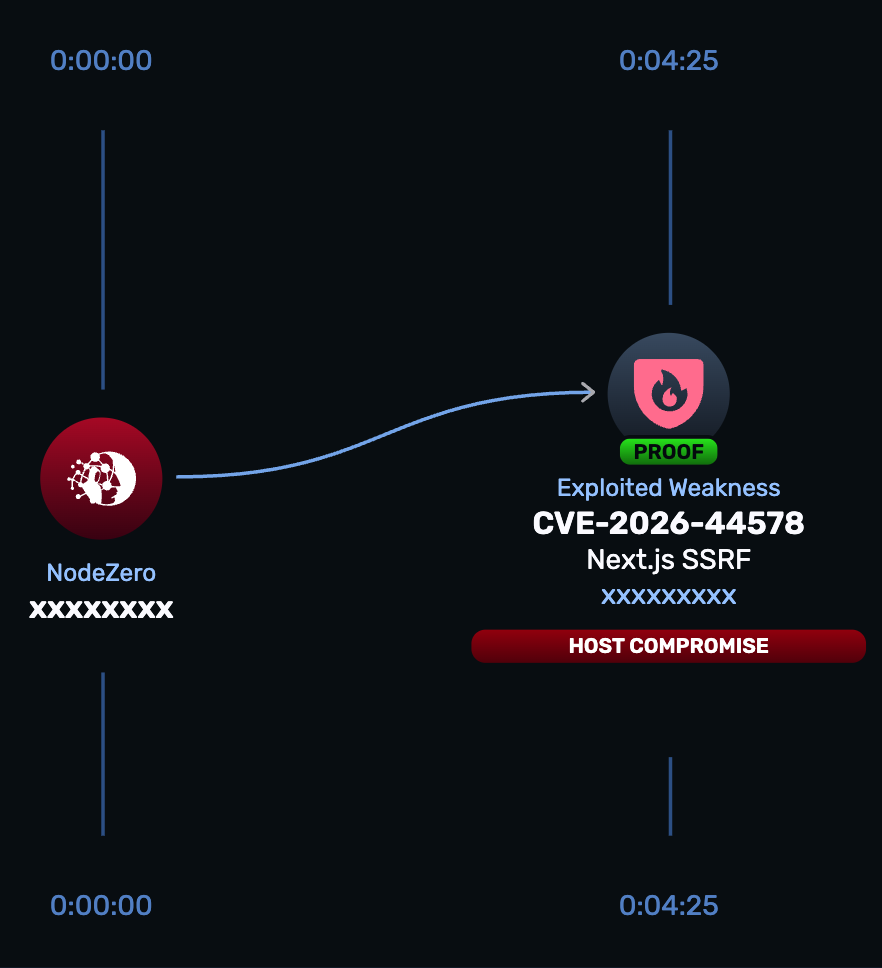
A NodeZero Rapid Response test has been developed to safely validate whether this server-side request forgery vulnerability can be exploited in your environment. The test executes real attack techniques without causing damage, giving teams immediate clarity on exposure.
Re-run the test: Confirm the vulnerability is no longer exploitable after remediation
Run the Rapid Response test: Launch from the NodeZero platform to determine whether affected self-hosted Next.js applications can proxy requests to unauthorized internal or external destinations
Patch immediately: Upgrade Next.js to version 15.5.16 or later for the 15.x branch, or 16.2.5 or later for the 16.x branch
Stop Guessing, Start Proving
Affected versions & patch
Affected:
- Next.js versions >= 13.4.13 and < 15.5.16
- Next.js versions >= 16.0.0 and < 16.2.5
- Self-hosted applications using the built-in Node.js server
Not affected:
- Vercel-hosted deployments
Patch:
- Upgrade to Next.js 15.5.16 or later
- Upgrade to Next.js 16.2.5 or later
Timeline
- May 6, 2026 – GitHub advisory GHSA-c4j6-fc7j-m34r was published for CVE-2026-44578.
- May 11, 2026 – The advisory was published to the GitHub Advisory Database.
- May 13, 2026 – NVD published CVE-2026-44578.
- May 14, 2026 – The GitHub advisory was last updated.