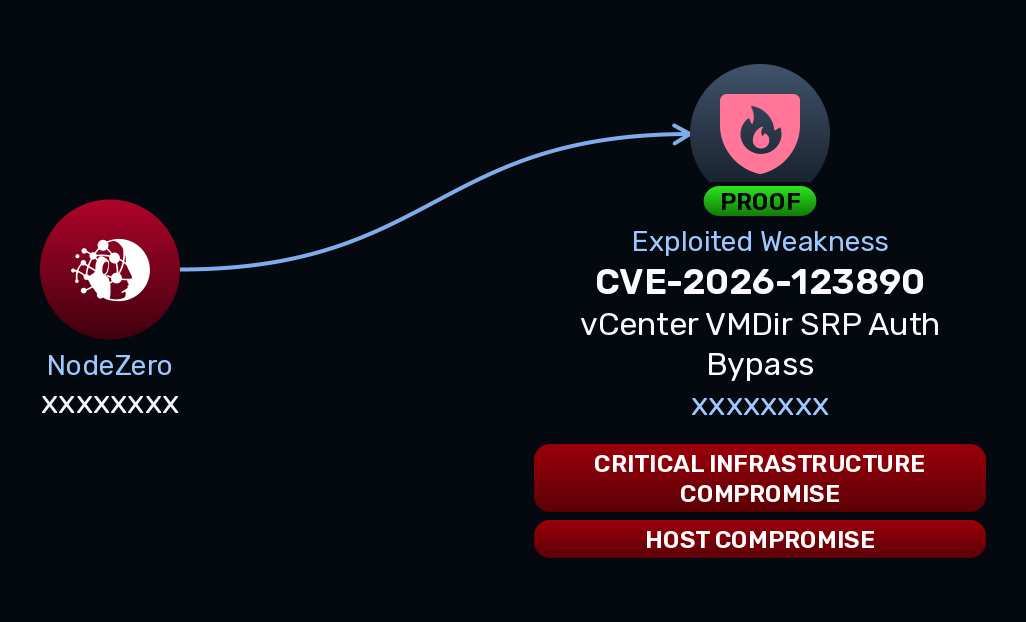
CVE-2026-123890
VMware vCenter Directory Service Authentication Bypass Vulnerability
CVE-2026-123890 is a critical authentication bypass in the VMware Directory Service component of VMware vCenter. An attacker with network access to vCenter, and no credentials, can obtain an authenticated session as the built-in administrator@vsphere.local account, taking control of the vSphere environment and the ESXi hosts and virtual machines it manages. Exploitation requires no user interaction or special configuration. Broadcom rates the vulnerability 9.8 (Critical) under CVSS v3.1 in Broadcom Security Advisory VMSA-2026-0009. Active exploitation has been confirmed in the wild: Google Threat Intelligence Group and Mandiant report that the suspected PRC-nexus actor ARMORY CASTLE exploited it as a zero-day from early September 2026, and CISA added it to the Known Exploited Vulnerabilities catalog on November 20, 2026.
Technical Details
The flaw is in the VMware Directory Service (vmdir), the LDAP-backed identity store behind vCenter Single Sign-On. Google Threat Intelligence Group’s analysis describes the root cause as unauthenticated disclosure of the SRP-6a session key over DCE/RPC; SRP-6a is the password-authenticated key exchange vmdir uses to establish a session. Because that key is recoverable without authenticating, an attacker can derive a valid session and present it as the default vSphere SSO administrator, administrator@vsphere.local. CVE-2026-123890 is distinct from CVE-2026-59309, an earlier VMware Directory Service bypass disclosed July 29, 2026; Google Threat Intelligence Group observed exploitation against a vCenter already patched for that issue.
Weakness: CWE-288, Authentication Bypass Using an Alternate Path or Channel
Attack vector: Network — the attacker needs network reachability to the vCenter Server appliance
Authentication: None required
User interaction: None required
Impact: Administrative access to vCenter as administrator@vsphere.local, with high confidentiality, integrity and availability impact
CVSS v3.1: CVSS:3.1/AV:N/AC:L/PR:N/UI:N/S:U/C:H/I:H/A:H (9.8, Critical, assigned by VMware)
Internet exposure is not required. In the intrusion Google Threat Intelligence Group documented, the attacker reached vCenter from inside the network after compromising a separate appliance.
NodeZero® Proactive Security Platform: Rapid Response
- Run the Rapid Response test: Launch the test from NodeZero to validate exploitability.
- Patch immediately: Upgrade to a fixed version or apply vendor-recommended mitigations.
- Re-run the test: Verify that the vulnerability is no longer exploitable after remediation.
Stop Guessing, Start Proving
Affected Versions & Patch
Affected
- VMware vCenter 9.1.x.x prior to 9.1.1.0200
- VMware vCenter 9.0.x.x prior to 9.0.2.0200
- VMware vCenter 8.0 prior to 8.0 U3m
- VMware vCenter 7.0 (no public fixed build listed)
- VMware Cloud Foundation vCenter 5.x prior to 5.2.5
- VMware Telco Cloud Platform 3.0, 4.x, 5.0.x, 5.1.x, 5.2 and VMware Telco Cloud Infrastructure 3.0
Fixed
- VMware vCenter 9.1.1.0200
- VMware vCenter 9.0.2.0200
- VMware vCenter 8.0 U3m
- VMware Cloud Foundation 5.2.5
- Telco Cloud Platform and Telco Cloud Infrastructure: per Broadcom KB463116
- VMware vCenter 7.0: Broadcom’s response matrix directs customers with an extended support contract to contact Broadcom Support. No public fixed build is listed.
Mitigations
Broadcom’s advisory lists no workaround for CVE-2026-123890; patching is the only vendor-provided remedy. Google Threat Intelligence Group additionally recommends restricting network access to the vCenter Server appliance, forwarding its logs to a SIEM, and reviewing vCenter for signs of prior compromise, noting that reactive patching alone is not sufficient.
Timeline
- September 2026: Google Threat Intelligence Group reports, based on forensic evidence, that ARMORY CASTLE exploited CVE-2026-123890 as a zero-day in early September 2026.
- November 19, 2026: Broadcom published Security Advisory VMSA-2026-0009, and the CVE record was published.
- November 19, 2026: Google Threat Intelligence Group and Mandiant published their analysis of the ARMORY CASTLE intrusion.
- November 20, 2026: Broadcom revised the advisory to VMSA-2026-0009.1.
- November 20, 2026: CISA added CVE-2026-123890 to the Known Exploited Vulnerabilities catalog, with a November 23, 2026 remediation due date for federal agencies.
References
- Broadcom Security Advisory VMSA-2026-0009
- NIST NVD Record: CVE-2026-123890
- CISA Known Exploited Vulnerabilities Catalog: CVE-2026-123890
- Google Threat Intelligence Group: ARMORY CASTLE Exploits vSphere
- The Hacker News: Critical VMware vCenter Zero-Day Flaw Lets Network Attackers Bypass Authentication