Find the Attack Paths that Matter Most.
See how Horizon3 turns security findings into clear, attacker-validated exposure insights and helps security teams prioritize remediation based on impact.


7,012
customers

Trusted by NSA and 4 of the Fortune 10
Which exposures are exploitable—and which matter most?
Security teams do not need more findings for the sake of more findings. They need confidence about which risks have the greatest impact, how weaknesses connect, and whether the work already completed actually reduced exposure.
Too many findings, not enough clarity
Find the exposures that create meaningful attack paths—not just another list of vulnerabilities.
Risk is difficult to validate
Move from assumptions to evidence by safely testing what can actually be exploited.
Fixes are difficult to prove
Show how remediation changes your real exposure and helps reduce the paths an attacker could take.
Focus on what matters
Start with the problem
Learn why scan, patch, and rescan workflows can still leave exploitable attack paths open—and what security leaders should validate instead.
Build a continuous approach
Learn how to turn CTEM from a framework into a repeatable process for discovering, validating, prioritizing, remediating, and verifying real-world exposure.
See the approach in practice
See why vulnerability counts and severity scores are not enough—and how security teams can focus on exploitability, attack paths, and real-world impact.
Turn vulnerability data into a clear path to action
Most security programs have more findings than they can investigate. Horizon3’s NodeZero helps teams identify what is exploitable, understand how weaknesses connect, and prioritize remediation based on potential impact.
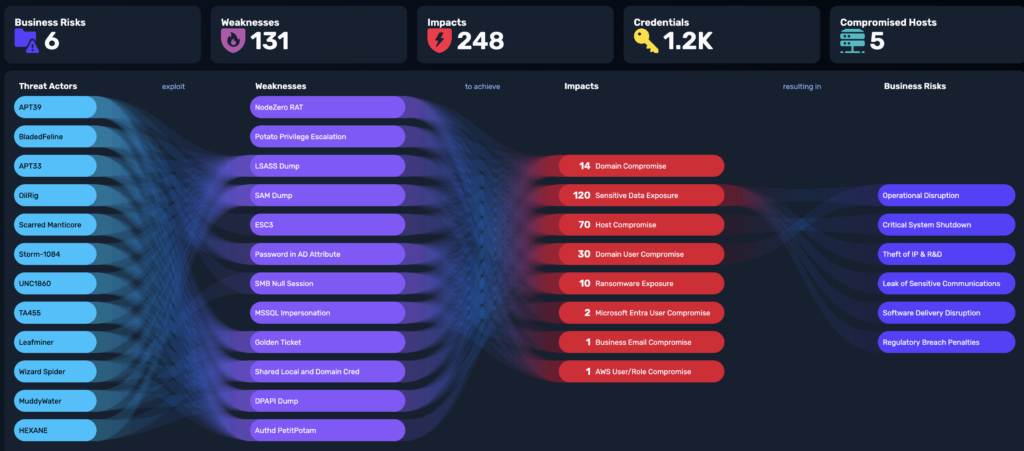
See what matters
Identify the exposures that create meaningful attack paths.
Validate what is real
Test exploitability instead of relying on assumptions or severity scores alone.
Focus the work
Prioritize the issues most likely to create business impact and reduce exposure.
See your environment the way an attacker would
NodeZero connects security findings to the attack paths they can create, helping your team understand where defenses can fail and what to address first.
1. Discover
Map weaknesses, identities, and exposures across the attack surface.
2. Validate
Test exploitability and chain related weaknesses into realistic attack paths.
3. Prioritize
Focus remediation on the paths with the greatest potential business impact.
The result is a clearer view of which risks are actionable, which fixes matter most, and how your exposure changes over time.


Want more? Go deeper with these resources.
Evaluate a modern pentest program
See what to evaluate in a pentesting program, including exploitability, adaptive attack-path chaining, fix validation, and measurable risk reduction.
See customer proof
See how TTEC used autonomous pentesting to uncover hidden attack paths, validate real-world exploitability, and build evidence for remediation and audit readiness.
Browse more evidence
Explore attack research, customer stories, webinars, whitepapers, and more resources.
See what NodeZero can uncover in your environment
In a guided walkthrough, the Horizon3 team will show how NodeZero identifies exposures, validates attack paths, and helps security teams prioritize remediation around real business challenges.
What you’ll get:
A clear look at how NodeZero discovers and validates attack paths
Examples of how security teams prioritize remediation
Time to discuss your current security-validation process and goals
Not seeing the form? Open the standalone form .