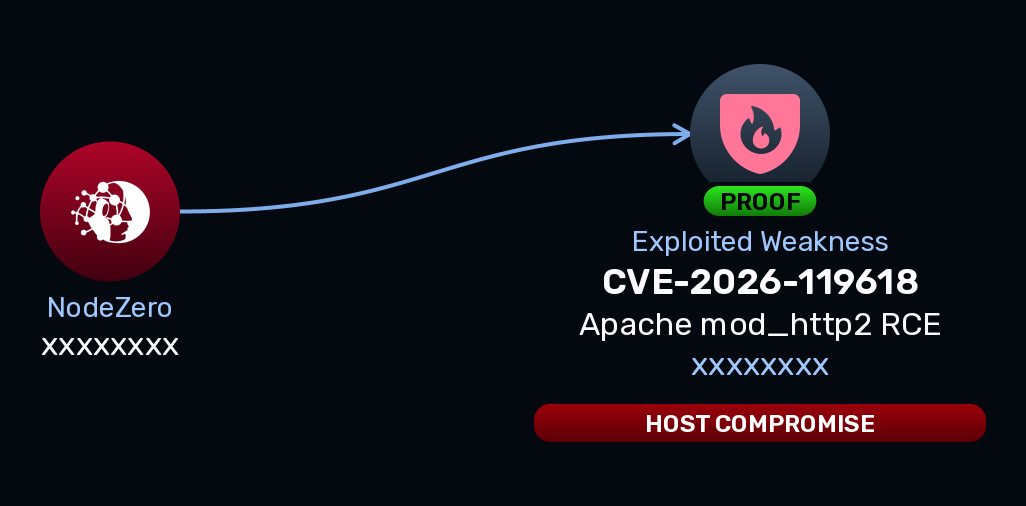
CVE-2026-119618
Apache HTTP Server mod_http2 Race Condition Remote Code Execution Vulnerability
CVE-2026-119618 is a critical race condition in mod_http2, the HTTP/2 module of the Apache HTTP Server. Improper synchronization of a shared resource in the module’s assign_headers() function corrupts heap memory and can lead to remote code execution. An attacker needs no credentials, only the ability to reach the server over HTTP/2; the Red Hat advisory states that only servers with HTTP/2 enabled are affected, which means servers that negotiate h2 or h2c through the Apache Protocols directive. The Apache Software Foundation advisory rates the vulnerability critical and publishes no CVSS score; Red Hat rates it 9.8 (Critical) under CVSS v3.1. A public proof of concept exists, but no in-the-wild exploitation has been confirmed at the time of this writing.
Technical Details
mod_http2 serves many concurrent HTTP/2 streams over a single connection, with request processing spread across worker threads. In assign_headers(), a worker thread writes into memory owned by the connection thread through a shared, lock-free allocator, without adequate synchronization. The result is heap corruption — corruption of the memory the server allocates at runtime — which an attacker can steer toward executing code in the context of the web server process.
Weakness: CWE-362, Concurrent Execution using Shared Resource with Improper Synchronization
Attack vector: Network. The attacker must reach a server that negotiates HTTP/2.
Authentication: None required.
User interaction: None required.
Impact: Heap corruption leading to remote code execution in the web server process, with high confidentiality, integrity and availability impact.
CVSS v3.1: CVSS:3.1/AV:N/AC:L/PR:N/UI:N/S:U/C:H/I:H/A:H (9.8, Critical)
Internet exposure is not required. Any Apache instance reachable from an untrusted network with HTTP/2 enabled is in scope, including internal reverse proxies and appliance management interfaces. Red Hat notes that the mod_http2 packages in Red Hat Enterprise Linux 9 and 10 allocate each HTTP/2 stream from a separate allocator, which substantially increases exploitation complexity, and rates those products Important rather than Critical.
Public exploitation research remains limited. A third-party proof of concept published on November 12, 2026 reproduces the heap corruption on 2.4.70 under memory and thread sanitizers and reports a clean result on 2.4.71; it does not demonstrate code execution, and its author is not affiliated with either team that reported the vulnerability. Red Hat’s advisory states that public research has demonstrated a reliable exploit against a default-configured server, but does not name or link that research. Neither Anthropic nor Google Cloud Vulnerability Research has published details of the original finding.
Stop Guessing, Start Proving
Affected Versions & Patch
Affected
- Apache HTTP Server from 2.4.55 through 2.4.70
- Affected releases of mod_h2 from GitHub: from 2.0.8 through 2.0.42
- Not affected: mod_http2 versions before 2.0.8, which Red Hat states do not contain the affected code.
Fixed
- Apache HTTP Server 2.4.71, released November 11, 2026
- Standalone mod_h2 from GitHub: no fixed release is listed in the Apache advisory. Servers running it should move to a patched Apache HTTP Server.
- Linux distributions ship the fix in their own mod_http2 or apache2 packages on separate timelines. Check the distribution’s advisory for the patched package version.
Mitigations
The Apache Software Foundation’s advisory publishes no workaround for CVE-2026-119618. Upgrading to 2.4.71 is the fix.
Because Red Hat states that only servers with HTTP/2 enabled are affected, disabling HTTP/2 removes exposure until the server can be patched. That means serving HTTP/1.1 only through the Apache Protocols directive:
Protocols http/1.1This must be applied in the server-wide configuration and in every virtual host that sets its own Protocols value, and it takes effect on restart. It costs HTTP/2 support and its performance benefits for every client. It is a workaround, not a fix.
Timeline
- October 26, 2026: Anthropic’s OSS Scanner reported the vulnerability to the Apache HTTP Server security team as ANT-2026-MAPKT6MZ.
- November 3, 2026: Anthony Weems and Simon Scannell of Google Cloud Vulnerability Research reported the vulnerability independently.
- November 11, 2026: The Apache Software Foundation published its advisory and released Apache HTTP Server 2.4.71 containing the fix.
- November 11, 2026: The CVE record for CVE-2026-119618 was published.
- November 12, 2026: A third-party proof of concept reproducing the heap corruption under sanitizers was published.
References
- The Hacker News: Critical Apache HTTP/2 Flaw Could Let Unauthenticated Attackers Execute Code Remotely
- Apache HTTP Server 2.4 Security Vulnerabilities Advisory
- CVE.org Record: CVE-2026-119618
- NIST NVD Record: CVE-2026-119618
- Red Hat Security: CVE-2026-119618
- GitHub: Third-party sanitizer-based reproduction lab for CVE-2026-119618