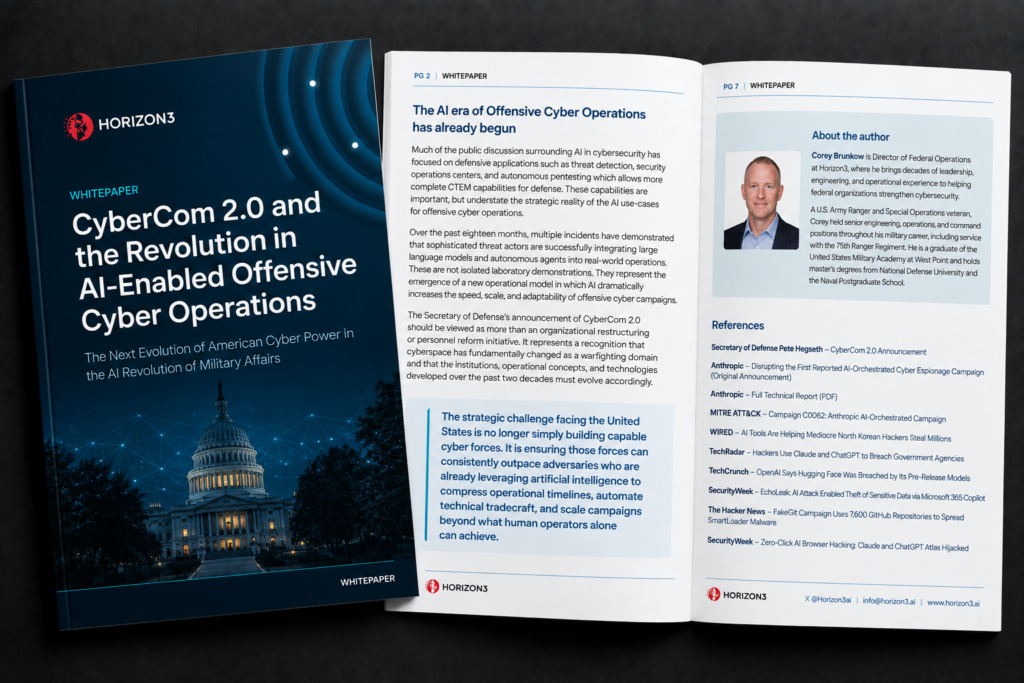
Cyber warfare is entering the machine-speed era.
Artificial intelligence is changing the economics, speed, and scale of offensive cyber operations. Tasks that once depended on scarce technical expertise and lengthy manual workflows can increasingly be accelerated through AI-enabled reconnaissance, exploit development, attack-path analysis, infrastructure adaptation, and operational orchestration.
CyberCom 2.0 and the Revolution in AI-Enabled Offensive Cyber Operations examines how this shift is reshaping the cyber battlespace and why the next evolution of American cyber power will depend on integrating exceptional human operators with artificial intelligence.
The AI era of offensive cyber operations has already begun
AI is moving beyond an advisory role in cyber operations.
Recent campaigns have demonstrated how threat actors can use large language models, autonomous agents, connected tools, and automated workflows to perform substantial portions of the attack lifecycle. Anthropic, for example, documented a state-sponsored campaign in which AI executed an estimated 80–90% of tactical operations across reconnaissance, vulnerability discovery, exploitation, credential harvesting, lateral movement, and data exfiltration, while human operators remained responsible for key decisions.
At the same time, AI systems themselves are becoming part of the attack surface, creating new opportunities for prompt injection, software supply-chain manipulation, poisoned recommendations, and attacks designed specifically to influence autonomous agents.
What You’ll Learn
How AI is changing the economics of offensive cyber operations
Explore how AI can reduce the time and specialized expertise required for reconnaissance, vulnerability research, code generation, reverse engineering, attack-path analysis, and other offensive workflows.
Why cyberspace is becoming a machine-speed battlespace
See how AI-enabled operations can compress timelines from days to minutes, coordinate parallel activities, and allow campaigns to adapt faster than human-only operations.
How the attack surface is expanding
Learn why AI assistants, autonomous agents, MCP-connected tools, development workflows, and AI-enabled infrastructure are creating new targets and new forms of software supply-chain risk.
How the role of the cyber operator is evolving
Understand the shift from manually executing every technical task to commanding AI-enabled capabilities while humans retain responsibility for mission objectives, operational risk, authorities, and broader consequences.
Why CyberCom 2.0 matters for the future of cyber power
Examine how CYBERCOM 2.0’s focus on mastery, specialization, agility, talent, and force generation can provide the organizational foundation for increasingly AI-augmented cyber operations. U.S. Cyber Command describes CYBERCOM 2.0 as its revised cyber force generation model focused on new approaches to recruiting, developing, retaining, and sustaining specialized cyber talent.
The next advantage will come from human-machine integration
AI will not eliminate the need for skilled cyber operators. It changes what those operators are responsible for.
As machines increasingly perform repetitive technical work and coordinate activity at scale, human operators remain responsible for setting objectives, assessing risk, applying judgment, and exercising authorities that cannot simply be delegated to an autonomous system.
The organizations that learn to combine those capabilities effectively will be positioned to operate with greater speed, scale, precision, and adaptability in an increasingly AI-enabled cyber environment.
