Cyber diplomacy has to move at the speed of the threat.
Nation-state actors and cybercriminals are using AI to find weaknesses, accelerate attacks, and exploit interconnected environments. Defending against them requires more than securing individual organizations. It means strengthening resilience across the partners, suppliers, critical infrastructure providers, and allies we depend on.
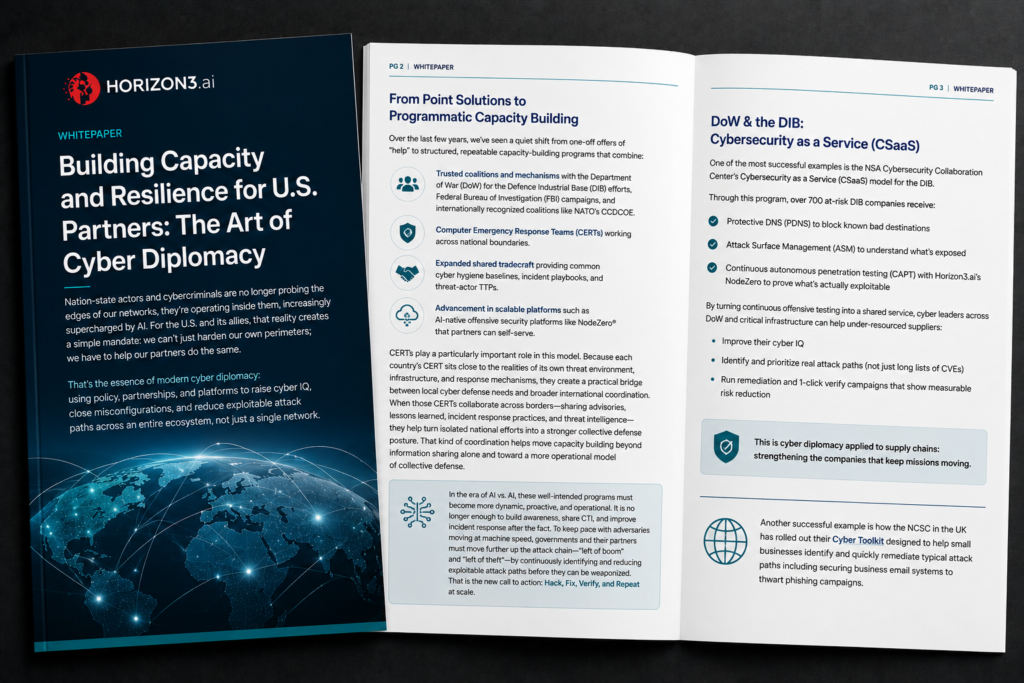
Building Capacity and Resilience for U.S. Partners: The Art of Cyber Diplomacy explores how governments and their partners can turn cyber diplomacy into an operational capability that reduces exploitable attack paths before adversaries weaponize them.
Move cyber capacity building left of boom
Threat intelligence, incident response, shared tradecraft, and international collaboration remain essential. But against adversaries operating at machine speed, information sharing alone is not enough.
The next step is proactive: give partners the ability to identify what attackers can actually exploit, fix the weaknesses that matter, verify remediation, and repeat at scale.
What You’ll Learn
How cyber diplomacy is becoming operational
See how CERTs, international coalitions, shared tradecraft, and scalable security platforms can turn one-time assistance into repeatable capacity-building programs.
What the DIB model proves
Explore how the NSA Cybersecurity Collaboration Center’s Cybersecurity as a Service model is helping protect 700+ Defense Industrial Base companies and 2.9M+ endpoints while giving under-resourced partners access to scalable cybersecurity capabilities.
Why offense-informed defense matters
Learn how mapping real attack paths across internal, external, cloud, and supply-chain environments helps defenders move beyond theoretical exposure and focus remediation on what attackers can actually exploit.
How AI changes the equation
Discover how AI-driven security can help defenders operate at machine speed, prioritize exploitable weaknesses, verify remediation, and reduce risk across entire ecosystems.
Cyber resilience is a shared mission
Adversaries do not respect organizational boundaries, national borders, or the distinction between .gov, .mil, and .com. A weakness in one partner can become an attack path into an entire ecosystem.
Modern cyber diplomacy gives partners the capabilities to act. Governments, allies, and critical partners can hack, fix, verify, and repeat on-demand while gaining a clearer view of systemic risk and where coordinated remediation can have the greatest impact.
