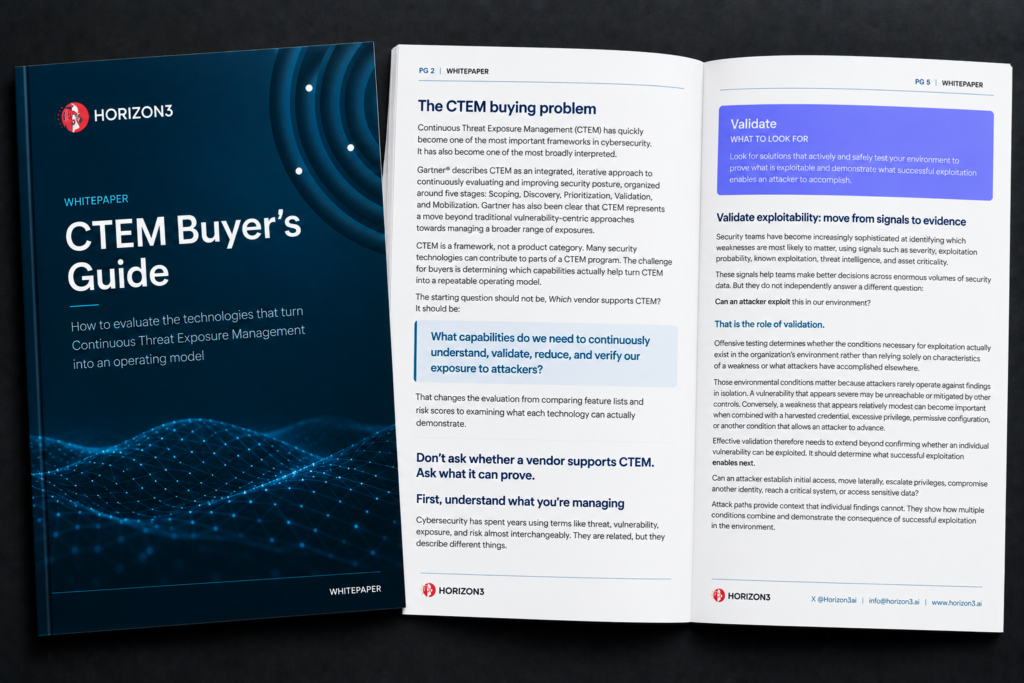
From CTEM Framework to Operating Model
Continuous Threat Exposure Management (CTEM) has become one of the most important—and broadly interpreted—frameworks in cybersecurity.
Gartner® describes CTEM as an integrated, iterative approach to continuously evaluating and improving security posture. But CTEM is a framework, not a product category. The challenge for buyers is determining which technologies can turn it into a repeatable operating model that reduces exposure to attackers.
Instead of asking which vendors support CTEM, ask: What can this technology prove about our exposure?
This buyer’s guide translates CTEM into a practical operating loop: Discover Exposure, Validate Exploitability, Prioritize With Confidence, Remediate With Clarity, Verify Risk Removal, and Repeat.
Learn how to evaluate solutions based on attacker evidence, attack-path context, remediation clarity, and measurable risk reduction, not simply findings or risk scores.
Inside the Guide
Learn how to:
- Understand the difference between threats, vulnerabilities, exposure, and risk.
- Evaluate how solutions uncover exposure across vulnerabilities, identities, credentials, misconfigurations, and security controls.
- See whether a solution can prove exploitability and demonstrate attacker impact.
- Prioritize remediation using proven exploitability, attack paths, and business impact.
- Verify that exposure is gone and track risk reduction over time.
- Ask five questions that separate CTEM claims from proof.
Who Should Read This
This buyer’s guide is designed for:
- Chief Information Security Officers (CISOs)
- Security Architects
- Exposure Management and Vulnerability Management leaders
- Security Operations and Security Engineering teams
- Cloud, Infrastructure, Identity, Application, and IT teams responsible for remediation
Download the CTEM Buyer’s Guide
Download the CTEM Buyer’s Guide to learn how to connect exposure to exploitability, remediation, verification, and measurable risk reduction.
Not seeing the form? Open the standalone form .
