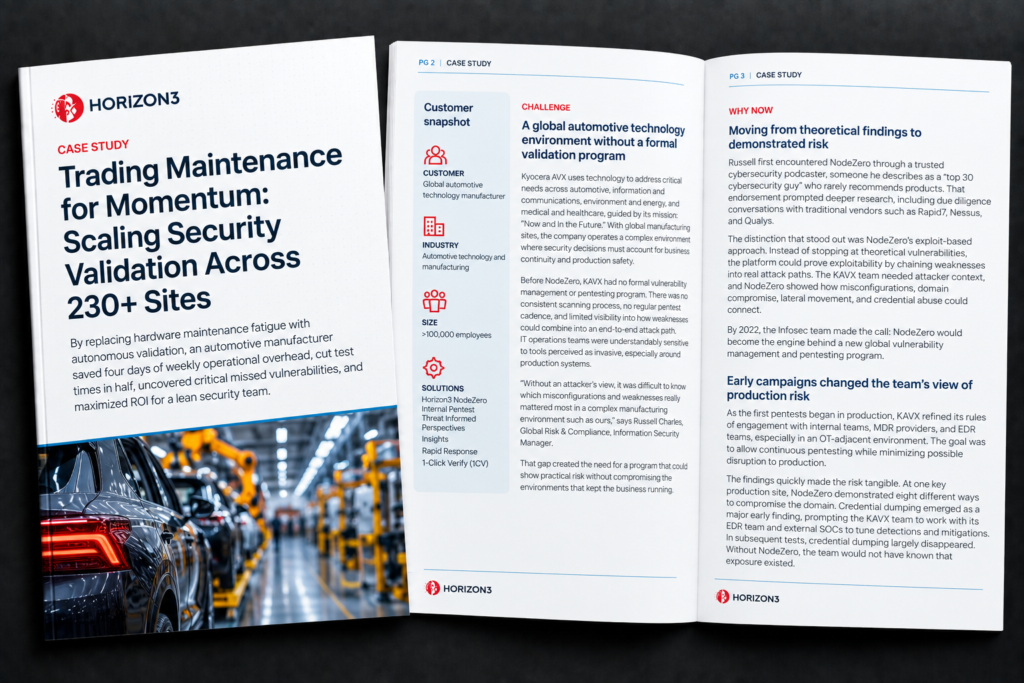
Security validation programs can become difficult to scale when the testing infrastructure itself creates operational drag.
A global automotive technology manufacturer had already built a substantial automated validation program, but maintaining appliances, VPN tunnels, updates, orchestration, and troubleshooting across more than 200 sites consumed significant time and limited broader coverage.
This customer story explores how the organization moved to NodeZero® to reduce operational overhead, expand validation across a distributed environment, and create a more scalable path from testing to remediation.
Key Insight
The challenge was not whether the team could run security tests. It was whether the program could keep scaling without turning highly skilled security staff into appliance administrators.
By moving to NodeZero, the organization gained:
- Centralized testing without a large hardware footprint
- Lightweight runners that could be reused across sites
- Broader visibility across more than 80,000 assets in a single assessment
- Faster test execution and broader vulnerability coverage
- Continuous remediation tracking with 1-Click Verify
- Rapid validation of newly relevant vulnerabilities with Rapid Response
- A scalable operating model for 230+ sites
What You’ll Learn
- Why hardware-heavy pentesting infrastructure can limit scale
- How centralized autonomous pentesting reduces operational overhead
- How NodeZero expanded visibility across a fragmented global environment
- Why newer vulnerability coverage mattered in the side-by-side evaluation
- How a lightweight runner model supported testing across hundreds of sites
- How Insights and Threat Informed Perspectives helped centralize coverage and trend visibility
- How 1-Click Verify connected remediation work back to validated outcomes
- How Rapid Response enabled faster checks against newly published vulnerabilities
- Why reducing test runtime can support a higher validation cadence
Why It Matters
Large, distributed manufacturers need recurring evidence of exploitable risk across factories, offices, data centers, cloud environments, and centralized identity infrastructure.
But the validation program itself can become a bottleneck when each site requires hardware maintenance, updates, troubleshooting, and manual coordination.
For this organization, the previous model consumed roughly four days of operational effort each week and left parts of the environment outside regular coverage.
NodeZero changed the operating model. The team moved to a centralized pool of lightweight virtual machines, preserved its tunnel-based architecture, and expanded testing without recreating the maintenance burden of the previous platform.
The results included:
- More than 190 of 230+ sites onboarded during the initial rollout
- Roughly 22 sites tested per week
- 82% site coverage during the initial pass
- Comparable test runtime reduced by 50%
- Twice as many weaknesses identified in comparable testing
- Hundreds of tests completed within the first two months of production
- More than 1,200 remediation tickets
- 300+ 1-Click Verify runs
- More than 250 remediation cases confirmed, with roughly 60 still open after verification
The broader shift was structural: the team moved from maintaining a complex testing operation toward continuously validating a large, changing environment through a central program.
Download the customer story to see how a global automotive manufacturer reduced testing overhead, expanded validation across 230+ sites, and built a more scalable path from attack validation to verified remediation.