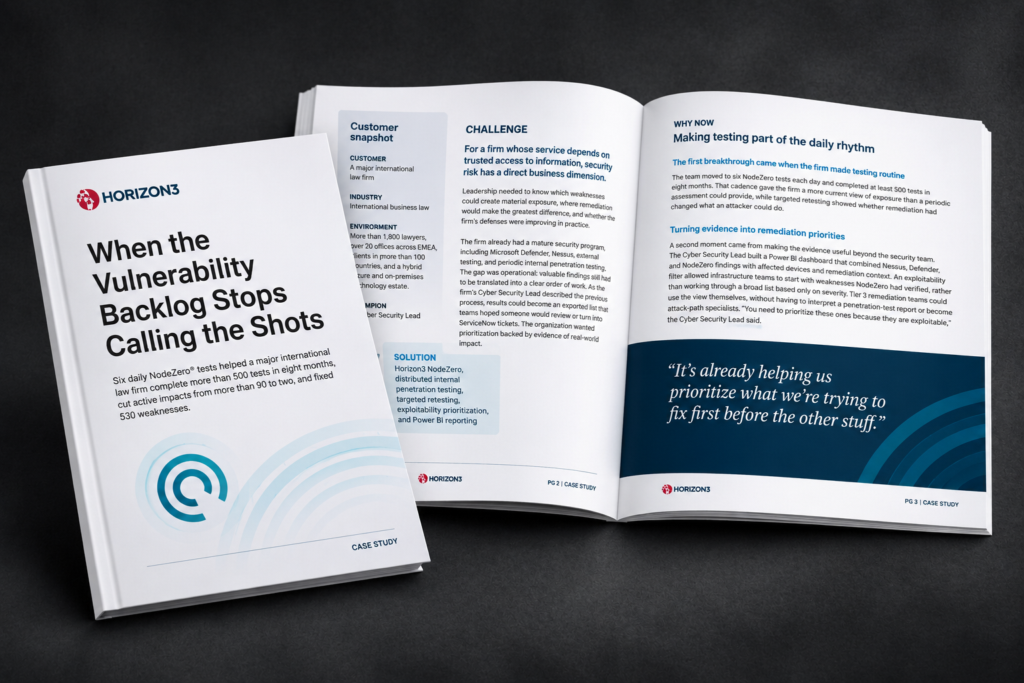
Six daily NodeZero® tests helped a major international law firm complete more than 500 tests in eight months, cut active impacts from more than 90 to two, and fixed 530 weaknesses.
For a firm whose service depends on trusted access to information, security risk has a direct business dimension. Leadership needs to know which weaknesses could create material exposure, where remediation will make the greatest difference, and whether the firm’s defenses are improving in practice.
A major international law firm faced that challenge. Its security program was already mature, with Microsoft Defender, Nessus, external testing, and periodic internal penetration testing. The gap was operational: valuable findings still had to be translated into a clear order of work, and the firm wanted prioritization backed by evidence of real-world impact.
This customer story explores how the firm used NodeZero® to run six tests a day, complete more than 500 tests in eight months, cut active impacts from more than 90 to two, and fix 530 weaknesses.
Key Insight
Valuable findings only help if teams know what to work on first. The firm’s Cyber Security Lead described the previous process as results that could become an exported list that teams hoped someone would review or turn into ServiceNow tickets. The firm wanted to prioritize based on evidence of real-world impact.
By making NodeZero part of its daily security operations, the firm gained:
- A daily testing rhythm of six NodeZero tests per day, with at least 500 tests completed in eight months
- Exploitability prioritization, so infrastructure teams could start with weaknesses NodeZero had verified rather than a broad list based only on severity
- A Power BI dashboard combining Nessus, Defender, and NodeZero findings with affected devices and remediation context
- Targeted retesting, with 281 verification tests showing whether fixes had changed the result
- Insight into a control gap behind a specific weakness (a blocked-password list missing from newly created domain controllers after upgrades)
- A governed path to extend coverage across international sites
Why It Matters
Security teams with mature programs can still struggle to turn findings into an order of work. Without evidence of real-world impact, a long list of weaknesses leaves remediation teams, and the leaders who depend on them, without a clear view of where exposure is concentrated.
The firm changed that dynamic.
By moving to six NodeZero tests each day, it gained a more current view of exposure than a periodic assessment could provide. The exploitability filter in its Power BI dashboard let infrastructure teams start with verified weaknesses. As the Cyber Security Lead put it, “You need to prioritize these ones because they are exploitable.”
Testing also revealed more than individual issues. It indicated that password spraying could compromise an Active Directory account and surfaced an old computer-account credential. Investigation found that a blocked-password list was missing from newly created domain controllers after upgrades. The firm changed affected account passwords and began implementing Entra-based password controls, addressing the deployment gap that allowed the weakness to persist.
The results: active impacts identified through testing fell from more than 90 to two, 530 weaknesses were fixed, and the team completed 281 verification tests. The firm has shifted from periodic assurance toward continuous, evidence-led security operations. It is now extending the model across its international sites and considering how the same discipline can support its expanding application estate.
Download the customer story to see how a major international law firm used NodeZero to make testing routine, prioritize exploitable weaknesses, and prove that fixes changed the outcome.