

From Attacker Story to Defender Story
Part 1, The Quiet Attack Path, showed how attackers enumerate Active Directory (AD), walked through the attacker’s first fifteen minutes inside GOAD (Game of Active Directory). The key lesson: native Kerberos and LDAP activity looks completely normal until it is too late. Part 2 flips to the defender’s point of view. We deploy AD Tripwires inside the same GOAD lab and show how a small set of purpose-built tripwire accounts produces deterministic alerts the moment an attacker touches credential material.
TL;DR
- What are AD Tripwires? Purpose-built tripwire accounts (exposed credentials, Kerberoasting, AS-REP) seeded in AD to light up the second an attacker pokes credential material.
- How they work: Watch Windows Security Events 4625, 4768, 4769, and 4771 for any reference to those accounts—any hit is attacker-only signal.
- Why it matters: Deterministic, low-noise telemetry that fires at the earliest step of the Attack Path and feeds right into Splunk Cloud, Microsoft Sentinel, or your SIEM/EDR.
- What we show: A GOAD walkthrough that pairs each tripwire account with the exact attacker move from Part 1 so you can see detection, event payload, and alert response end to end.
Setting the Stage: GOAD’s Real Victims
Before adding any tripwires, GOAD already contains vulnerable production accounts—the same ones our autonomous operations abused in Part 1.
| Account | Why it is vulnerable | What the attacker does with it |
samwell.tarly | Cleartext password exposed via SMB null session | Provides first authenticated domain foothold |
jon.snow | Service account with SPN, weak password hygiene | Classic Kerberoasting target once a foothold exists |
missandei | Kerberos pre-authentication disabled (legacy setting) | Enables unauthenticated AS-REP Roasting |
These are “real” users. Touching them might blend into legitimate helpdesk noise, which is exactly why defenders struggle to spot the attack path. We introduce tripwire accounts to change the story.
The Tripwire Cast (Safe by Design)
Tripwire accounts are planted specifically to catch reconnaissance. They never hold privileges, are never tied to applications, and use long, random passwords so that any interaction is unambiguously hostile.
| Tripwire Type | Bait the attacker sees | Signal we monitor |
| Exposed Credentials | Friendly Description field that “leaks” a fake secret | Failed logon (4771/4625) using the fake password |
| Kerberoasting | Legit-looking service account with a safe SPN | TGS request (4769) for that SPN |
| AS-REP Roasting | Account with pre-auth disabled | AS-REQ / TGT request (4768, sometimes 4771) |
Because these accounts are never used by production workflows, baseline noise rounds to zero. If they fire, someone is enumerating AD with malicious intent.
Turning Recon into Deterministic Alerts
AD Tripwires subscribes to a handful of Windows Security Events on the Domain Controller. Each alert contains the tripwire account, source host/user, Domain Controller, timestamp, and event payload that matters for triage. The three event families to watch:
- Failed logons (4625 / 4771) — exposed-credential tripwires when someone tries the fake Description password.
- Service ticket requests (4769) — Kerberoasting tripwire SPNs requested for offline cracking.
- Authentication ticket requests (4768 / optional 4771) — AS-REP tripwires where pre-auth is disabled.
That is the entire playbook: plant the lures, monitor the four event IDs, forward the alerts to Splunk Cloud, Microsoft Sentinel, or your SIEM/EDR, and respond immediately.
GOAD Walkthrough — Three Mini-Stories
The examples below come from a GOAD (Game of Active Directory) environment—a widely used enterprise-style reference architecture for AD security validation. We deployed AD Tripwires alongside the existing GOAD infrastructure, then ran autonomous pentesting operations to demonstrate how tripwire accounts surface attacker behavior in real time.
Scenario 1: Exposed Credentials Tripwire
Attack Path
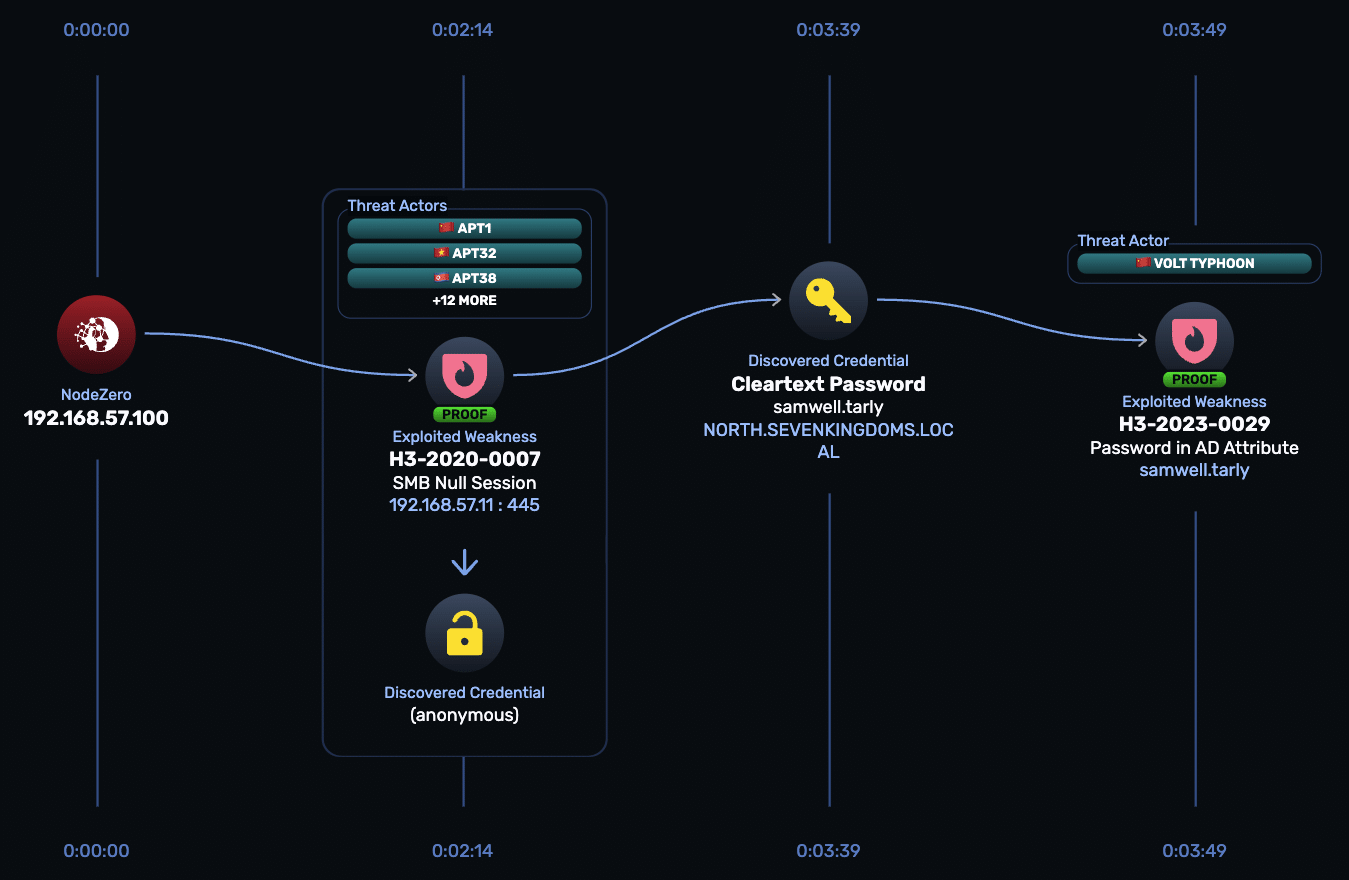
This attack path shows how quickly an exposed credentials tripwire account lights up:
- 00:00 → SMB null session (H3-2020-0007). Anonymous access to
192.168.57.11:445yields discovery of theanonymouscredential. - 00:02 → Cleartext password exposure (H3-2023-0029). The session uncovers a cleartext password for
samwell.tarlystored in an Active Directory attribute. - 00:03 → Domain user ready. With valid credentials, the operator now has authenticated domain access to pivot into Kerberoasting or AS-REP Roasting.
Tripwire Configuration

Tripwire account details:
- Account name:
svc_backup_legacy - Description field:
pw: iMhZFDkLYzR7nKaIhtuH - Actual password: Long complex randomly generated string (not
iMhZFDkLYzR7nKaIhtuH) - Group membership: Domain Users only (no privileges)
What the Attacker Sees
During Lightweight Directory Access Protocol (LDAP) enumeration, the attacker harvests the Description field and attempts to authenticate with iMhZFDkLYzR7nKaIhtuH.


Windows Security Event
When the attacker tries the fake password, the Domain Controller logs a failed logon:
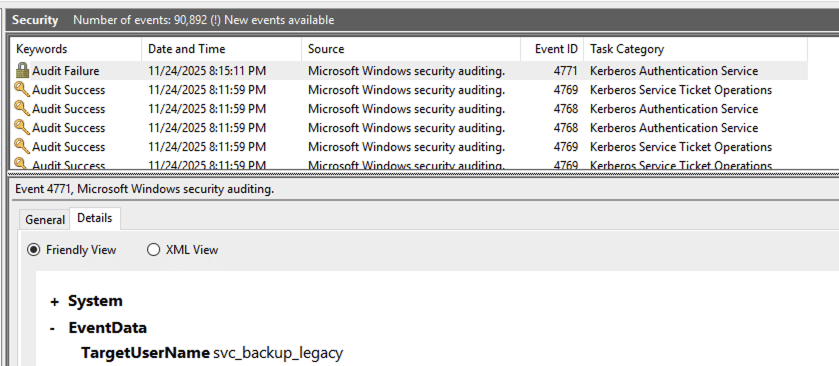
Key fields:
- Event ID: 4771 (Kerberos pre-authentication failed)
- TargetUserName:
svc_backup_legacy - ServiceName:
krbtgt/NORTH - FailureCode:
0x18(bad password) - Ticket Options:
0x40810010(indicates pre-auth failure) - Client Address:
192.168.57.100(attacker host)
Platform Alert
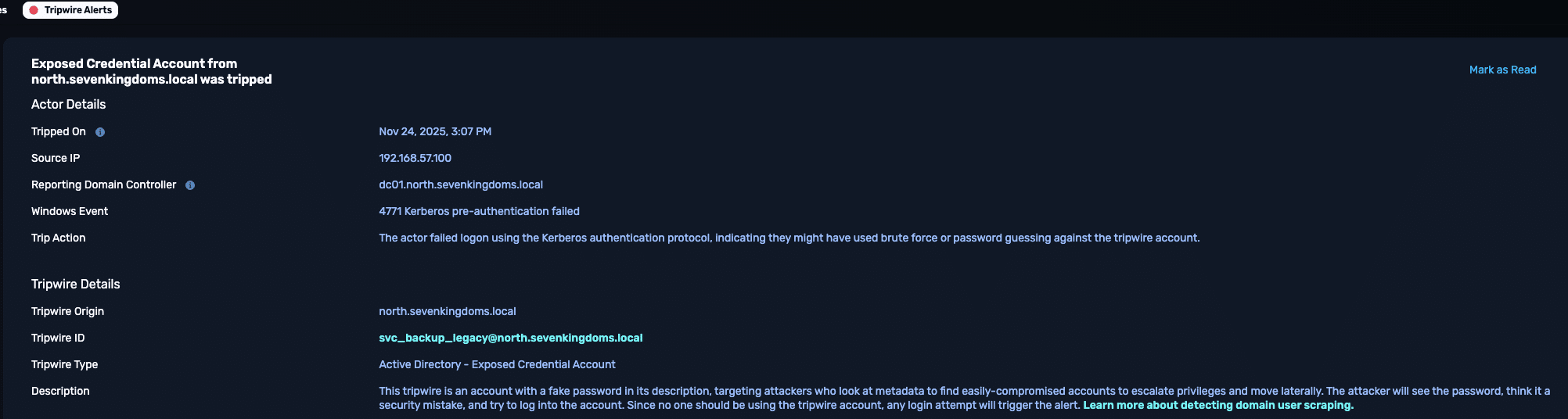
| Tripwire type | Exposed Credentials |
| Tripwire ID | svc_backup_legacy@north.sevenkingdoms.local |
| Tripwire origin | north.sevenkingdoms.local |
| Source IP | 192.168.57.100 |
| DC observed | DC01.north.sevenkingdoms.local |
| Timestamp | Oct 10, 2025 4:03 PM UTC |
| Windows Event | 4771 Kerberos pre-authentication failed |
| Guidance | “The actor failed logon using the Kerberos authentication protocol, indicating they might have used brute force or password guessing against the tripwire account.” |
Scenario 2: Kerberoasting Tripwire
Attack Path
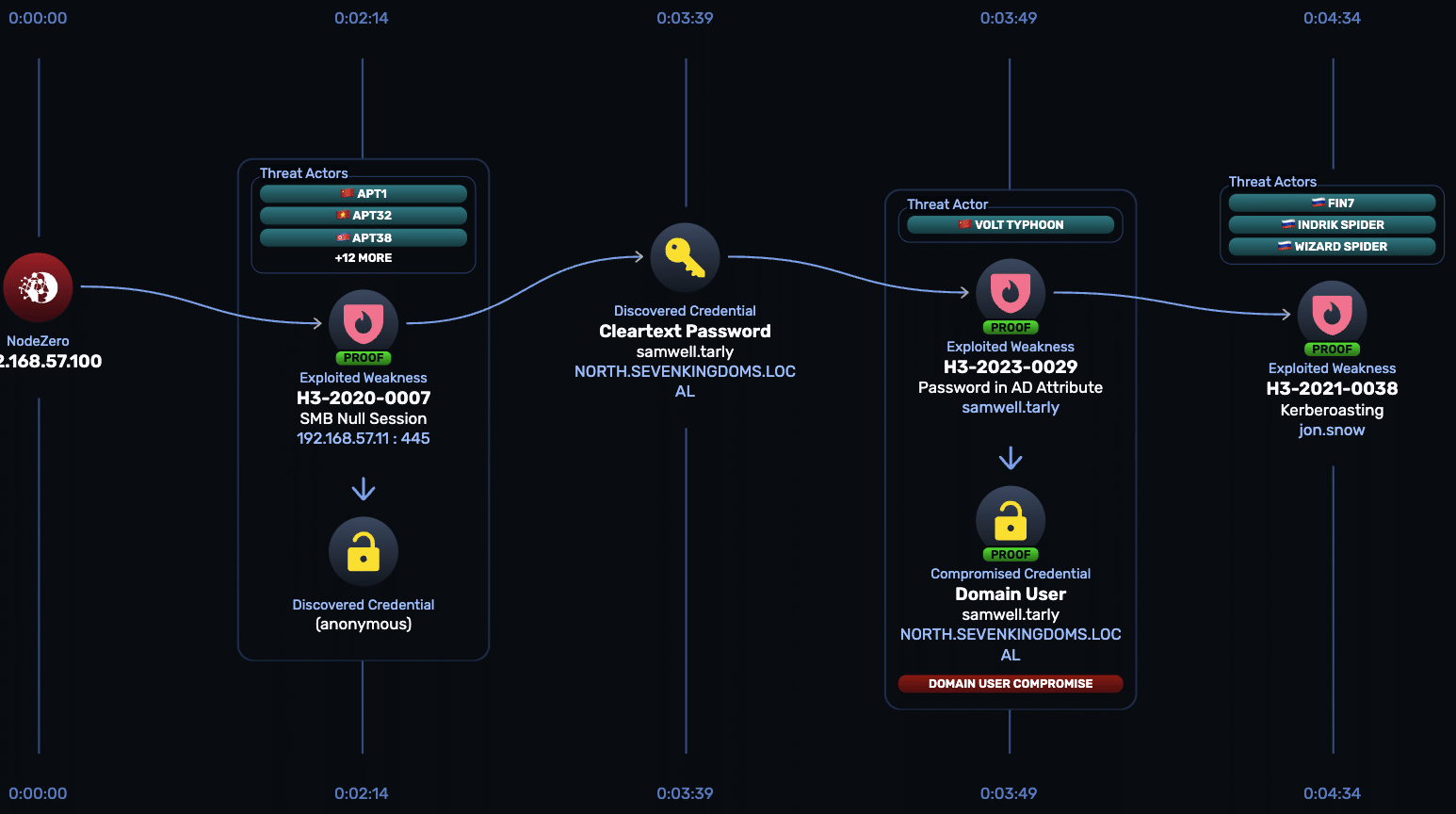
This GOAD scenario shows the attacker flow from initial access to Kerberoasting:
- 00:00 → SMB null session. Anonymous access to
192.168.57.11:445(H3-2020-0007) yields an initial credential foothold. - 00:02 → Domain metadata scrape. The null session reveals the cleartext password for
samwell.tarlystored in an Active Directory attribute (H3-2023-0029). - 00:03 → Domain user compromise. The recovered password grants an authenticated domain user session for
samwell.tarly. - 00:04 → Kerberoasting. With domain user access, the attacker requests a service ticket for
jon.snow(H3-2021-0038), exporting it for offline cracking.
Tripwire Configuration

Tripwire account details:
- Account name:
svc_sql_reporting - SPN:
HTTP/test-webserver.internal - Password last set:
2025-11-20 23:20:06 UTC(long, randomly generated value) - Actual password: 32-character randomly generated string
- Group membership: Domain Users only (no privileges)
What the Attacker Sees
During SPN enumeration, the attacker identifies svc_sql_reporting as a Kerberoastable target and requests a Ticket-Granting Service (TGS) ticket.
$ python3 GetUserSPNs.py north.sevenkingdoms.local/samwell.tarly \
>     -dc-ip 192.168.57.11 \
>     -target-svc svc_sql_reporting \
>     -request \
>     -outputfile svc_sql_reporting.hashes
Impacket v0.12.0 - Copyright 2024 SecureAuth Corporation

Password:
ServicePrincipalName                Name               MemberOf                                                          PasswordLastSet             LastLogon                   Delegation
----------------------------------- ------------------ ---------------------------------------------------------------- -------------------------- -------------------------- ----------
HTTP/test-webserver.north.sevenkingdoms.local
                                    svc_sql_reporting  CN=Domain Users,CN=Users,DC=north,DC=sevenkingdoms,DC=local        2025-11-20 23:20:06.000000  2025-11-21 15:04:11.000000  <no>

$krb5tgs$23$*svc_sql_reporting$NORTH.SEVENKINGDOMS.LOCAL$HTTP/test-webserver.north.sevenkingdoms.local*$3a6f1b0c...:5b8c9d0e...
TGS hash written to svc_sql_reporting.hashes
Windows Security Event
When the attacker requests the service ticket, the Domain Controller logs the TGS request:
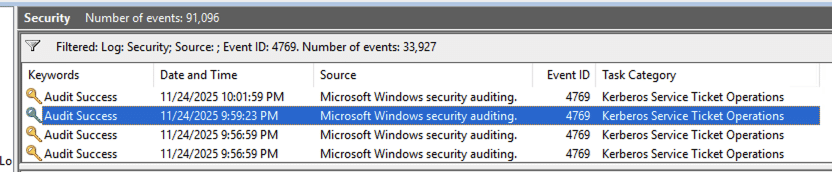

Key fields:
- Event ID: 4769 (A Kerberos service ticket was requested)
- Service Name:
MSSQLSvc/sql-reporting.north.sevenkingdoms.local:1433 - Account Name:
samwell.tarly(requesting user) - Client Address:
::ffff:10.49.30.25 - Ticket Encryption Type:
0x17(RC4-HMAC, common for Kerberoasting)
Platform Alert
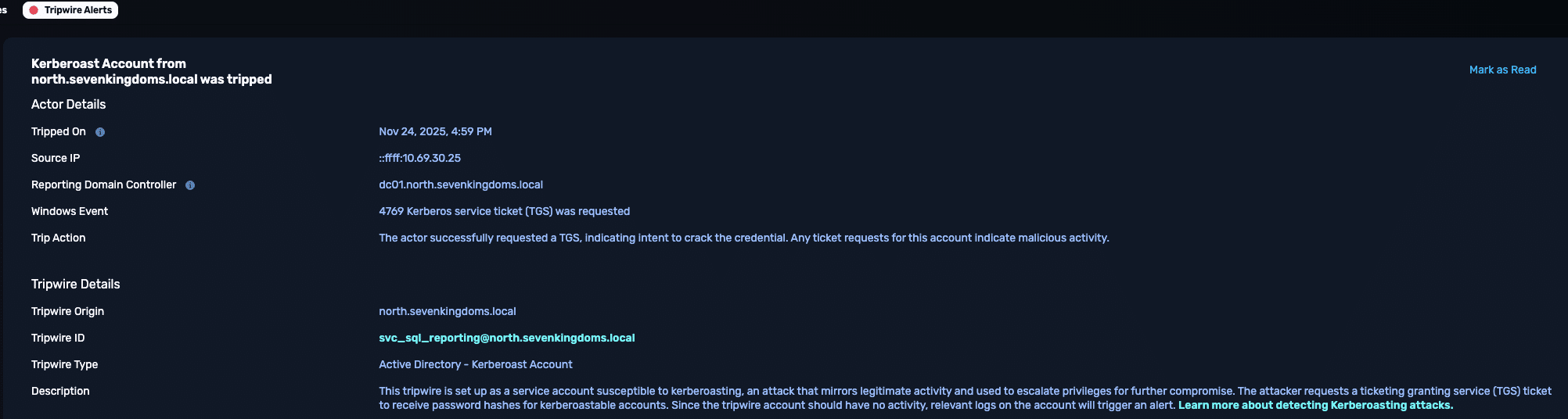
| Tripwire type | Kerberoasting |
| Tripwire origin | north.sevenkingdoms.local |
| Tripwire ID | svc_sql_reporting@north.sevenkingdoms.local |
| Source IP | ::ffff:10.49.30.25 |
| Reporting DC | dc01.north.sevenkingdoms.local |
| Timestamp | Nov 24, 2025 4:59 PM |
| Windows Event | 4769 Kerberos service ticket (TGS) was requested |
| Guidance | “The actor successfully requested a TGS, indicating intent to crack the credentials. Any ticket requests for this account indicate malicious activity.” |
Scenario 3: AS-REP Roasting Tripwire
Attack Path
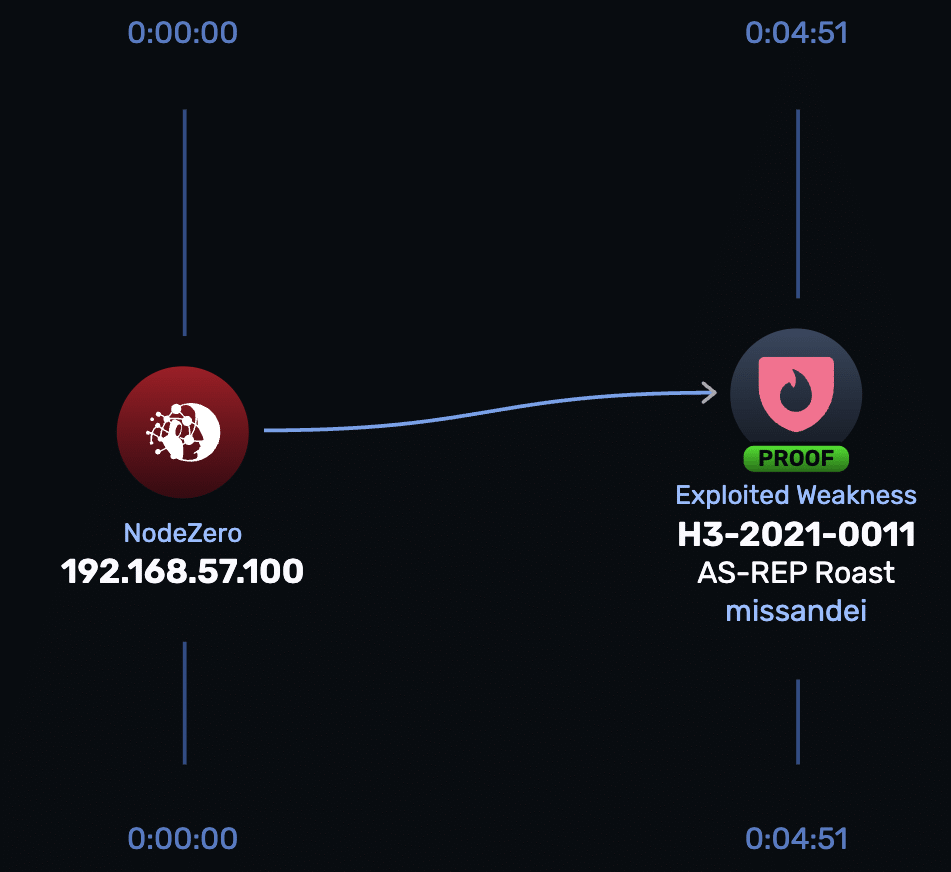
This single-step GOAD path demonstrates unauthenticated AS-REP Roasting against a legacy account:
- 00:00 → NodeZero scope. The operation begins from a beachhead at
192.168.57.100with domain reconnaissance enabled. - 00:04 → AS-REP Roast (H3-2021-0011). Because
missandeihas Kerberos pre-authentication disabled, NodeZero requests an Authentication Service reply (AS-REP) without presenting credentials and captures the hash for offline cracking.
Tripwire Configuration

Tripwire account details:
- Account name:
svc_legacy_app - Pre-authentication: Disabled (“Do not require Kerberos preauthentication” checked)
- Actual password: Long complex randomly generated string
- Group membership: Domain Users only (no privileges)
What the Attacker Sees
During user enumeration, the attacker identifies svc_legacy_app as having pre-authentication disabled and requests an AS-REP without credentials.
$ python3 GetNPUsers.py north.sevenkingdoms.local/ \
>     -dc-ip 192.168.57.11 \
>     -usersfile tripwire_users.txt \
>     -format hashcat \
>     -outputfile svc_legacy_app.asrep
Impacket v0.12.0 - Copyright 2024 SecureAuth Corporation

[*] No authentication required: attempting AS-REP roast
[*] Using KDC(s):
    192.168.57.11

[-] User missandei does not have UF_DONT_REQUIRE_PREAUTH set
[-] User svc_sql_reporting does not have UF_DONT_REQUIRE_PREAUTH set
[+] Got AS-REP for svc_legacy_app (hash written to svc_legacy_app.asrep)
$krb5asrep$23$svc_legacy_app@NORTH.SEVENKINGDOMS.LOCAL:1c7a...5e9d$cc2f0a9d9e0c0b3c9...f8d1e2
Windows Security Event
When the attacker requests the AS-REP, the Domain Controller logs the authentication attempt:
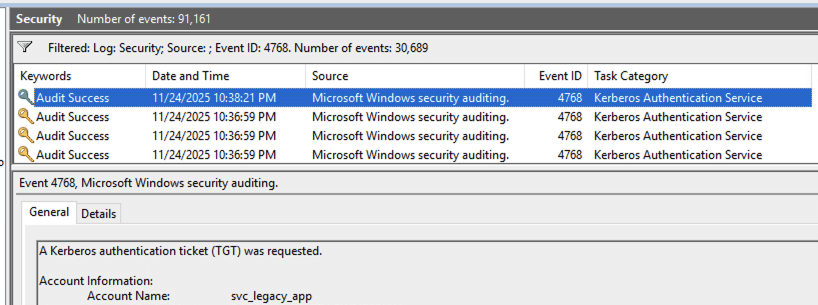
Key fields:
- Event ID: 4768 (A Kerberos authentication ticket (TGT) was requested)
- TargetUserName:
svc_legacy_app - IpAddress:
192.168.57.100 - Ticket Options:
0x50800000(indicates pre-auth not required)
Platform Alert
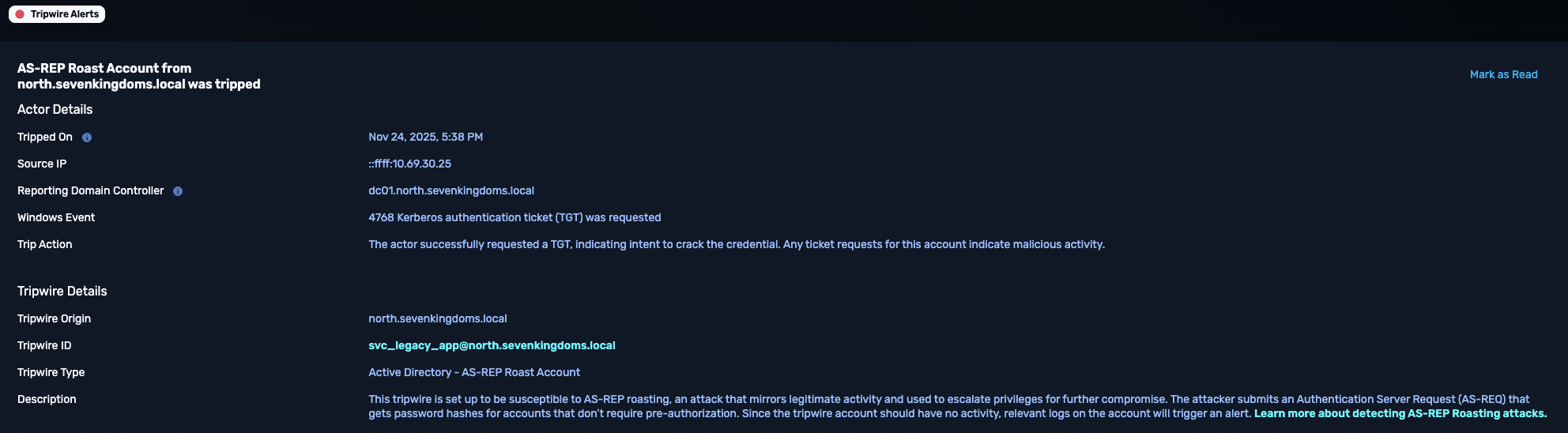
| Tripwire type | AS-REP Roasting |
| Tripwire origin | north.sevenkingdoms.local |
| Tripwire ID | svc_legacy_app@north.sevenkingdoms.local |
| Source IP | ::ffff:10.49.20.25 |
| Reporting DC | dc01.north.sevenkingdoms.local |
| Timestamp | Nov 24, 2025 5:38 PM |
| Windows Event | 4768 Kerberos authentication ticket (TGT) was requested |
| Guidance | “The actor successfully requested a TGT, indicating intent to crack the credentials. Any ticket requests for this account indicate malicious activity.” |
Why AD Tripwires Are Effective
- Deterministic, not heuristic: Tripwire accounts are dormant. Any touch is an attacker, period.
- Earliest point in the Attack Path: Alerts fire during reconnaissance/collection—well before domain admin or data access.
- Low noise: No production services reference these accounts; allowlist your own security scanners and you’re done.
- Built for operations: Alerts route through AD Tripwires into Splunk Cloud, Microsoft Sentinel, or your SIEM/EDR with the right context for playbooks.
Deploying and Validating in Your Environment
- Create the tripwire accounts exactly as listed above—no privileges, random passwords, enticing metadata/SPNs/pre-auth toggles.
- Enable DC auditing for 4625, 4768, 4769, and 4771. Forward those events (or the AD Tripwires alerts) into your logging pipeline.
- Test from a lab host: Intentionally trigger each tripwire to confirm alert routing, timestamps, and enrichment.
- Fold alerts into playbooks: Route as “Credential Access: Kerberos,” isolate the source, snapshot volatile data, and hunt for adjacent enumeration (LDAP, SMB, WinRM).
- Optionally forward raw DC security logs with the same Event IDs if you want additional hunting context beyond the triaged alerts.
- Keep Kerberos hygiene tight: ensure accurate time sync and hostname resolution; Kerberos drifts create false negatives.
- Enforce the safe-by-design rules: no privileged group membership, no application bindings, long random passwords across all tripwire types.
These steps require zero Active Directory re-architecture. You are simply adding three bait accounts, wiring the alerts, and treating them as an early-warning control that complements SIEM/EDR.
Why Not Just EDR?
Endpoint tools struggle with GOAD’s quiet attack path because native Kerberos and LDAP activity is indistinguishable from normal administrator work. Tripwire accounts change that math: they are never referenced by production services or users, so any authentication attempt or ticket request that names them shows up as a deterministic signal in Windows Security Events (4625, 4769, 4768, 4771).
AD Tripwires watches those logs (or receives them directly) and raises alerts the instant a failed logon, TGS request, or AS-REQ touches a tripwire account, dramatically shrinking false positives while flowing straight into Splunk Cloud, Microsoft Sentinel, or your SIEM/EDR. That telemetry closes the exact gap highlighted in Part 1—those stealthy Kerberoasting and AS-REP Roasting moves now leave a crisp, attributable trail that defenders can act on before the attacker escalates.
Architecture at a Glance

Detailed description:
- The attacker host performs three actions against Active Directory:
- LDAP/AD reconnaissance of users/descriptions/SPNs.
- Kerberos TGS request targeting the Kerberoasting tripwire account.
- Kerberos AS-REQ targeting the AS-REP Roasting tripwire account (pre-auth disabled).
- Domain Controllers log relevant Windows Security Events (commonly 4625, 4768, 4769, and 4771).
- AD Tripwires monitors for tripwire account interactions and emits deterministic trip events with context (tripwire account name, source host/user, DC observed, timestamp).
- The platform forwards alerts to Splunk Cloud or Microsoft Sentinel (or your SIEM/EDR) via built-in integrations for analyst triage and playbook execution.
Detection Tuning Tips
Keep the signal sharp with a few deliberate moves: allowlist any scanner or asset-inventory hosts that legitimately touch the tripwire accounts, crank severity when a single source brushes multiple tripwires in a short window, correlate trip events with spikes in LDAP user/SPN enumeration, and enrich the alert payload with network zone or asset criticality so analysts know whether they are looking at a lab VM or a domain controller.
What This Stops in Practice
Those small adjustments shut down the patterns we keep seeing in real environments: recon that turns into password spraying against “obvious” description strings, Kerberoasting that feeds offline cracking rigs, and AS-REP Roasting against forgotten legacy users. Forcing an operator to touch a tripwire that looks authentic converts quiet, native traffic into deterministic, actionable detections.
What AD Tripwires Won’t Detect
Tripwires only see the interactions that reference them. Credential abuse that never hits the planted accounts (pass-the-hash, token theft), golden/silver ticket usage, the actual offline cracking phase, or legitimate admin work untouched by the lures will flow past. Treat AD Tripwires as an early-warning layer that augments, not replaces, the rest of your SIEM/EDR and identity controls.
MITRE ATT&CK Mapping
- Discovery:
- Credential Access (Kerberos):
Where to Go Next
- Validate your environment: do real accounts have SPNs that shouldn’t? Any users with pre-auth disabled? Descriptions with secrets?
- Turn on AD Tripwires: seed the tripwire accounts, verify event flow, and test with your red team to see the alerts end-to-end.
- Fold the alerts into response playbooks: isolate source hosts, snapshot volatile evidence, and hunt for adjacent enumeration.
- Run a safe test: trigger each tripwire account to validate end-to-end alert routing and playbook activation before production rollout.
For deployment and operational guidance, see the AD Tripwires documentation and product pages in Related Reading.
Related Reading
- Part 1: The Quiet Attack Path—How Attackers Own Active Directory in Minutes
- From CVE-2022-33679 to Unauthenticated Kerberoasting (Horizon3.ai research)
- H3-2021-0038 (Horizon3.ai Knowledge Base)
- Metrics That Matter: An Attacker’s Perspective on Assessing Password Policy
- NodeZero Tripwires overview (product)
- AD Tripwires product page
- AD Tripwires documentation